
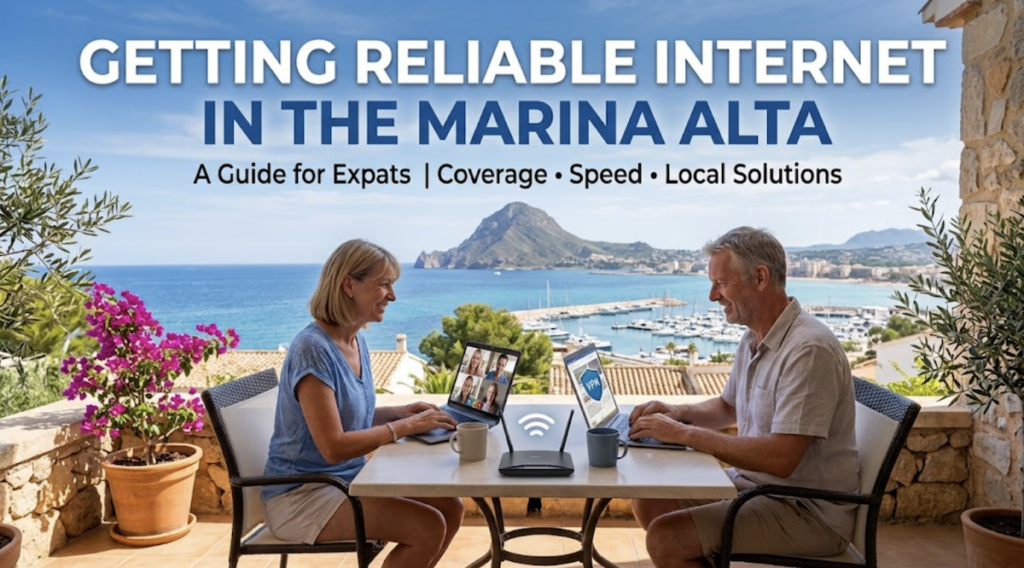
Moving to the Marina Alta — or spending a significant part of the year here — is one of the best decisions you can make. The climate, the coastline, the pace of life, the food, the community. But sorting out your internet connection is one of those practical hurdles that can be surprisingly frustrating if you don’t know the local landscape.
The big national operators — Movistar, Vodafone, Orange — are familiar names, but navigating their contracts in Spanish, understanding the fine print around permanence clauses, and getting actual technical support when something goes wrong can be a challenge for anyone who isn’t fluent in the language or familiar with how things work here.
This guide covers everything you need to know about getting reliable internet in the Marina Alta as a foreign resident — whether you’re in Jávea, Dénia, or one of the smaller municipalities inland.
The Marina Alta expat community: who’s here and what they need
The Marina Alta has one of the highest concentrations of foreign residents in the province of Alicante. The British community is particularly well established — many families have lived here for decades — but there are also large Dutch, German, Scandinavian and Belgian communities, especially around Jávea, Dénia and the surrounding areas.
Within that expat population, internet needs vary widely:
- Retired residents who use the internet mainly for video calls with family back home, streaming British TV (via VPN), and basic browsing.
- Remote workers and digital nomads who need a stable, fast, symmetric connection for video calls, cloud tools and file uploads.
- Seasonal residents who split their time between Spain and their home country and want a flexible contract with no long-term commitment.
- Property owners who rent their home on Airbnb or Booking and need reliable WiFi for guests even when they’re not in Spain.
At PCStar, we work with all these profiles. We understand that the needs of a retired British couple in a villa on the Montgó are very different from those of a Dutch remote worker in a flat in Jávea town centre.
The permanence problem: why contracts catch expats off guard
One of the most common frustrations for expats setting up internet in Spain is the permanence clause, the minimum contract period. Most national operators require a 12 month commitment. If you cancel before that period ends, you pay a penalty that can amount to several months of fees.
For seasonal residents who are only here for part of the year, this is a real problem. Paying for 12 months of internet when you’re only in Spain for 4 or 5 months means you’re effectively paying for 7 months of a service you’re not using.
PCStar offers contracts without permanence: you pay a one-time installation fee of €150, and from that point on you can activate and deactivate the service whenever you need it, with no penalties. If you leave in October and come back in April, you simply reactivate. The infrastructure stays in place; you only pay for the months you use it.
Coverage in the Marina Alta: what to expect depending on where you live
Coverage varies significantly depending on your exact location. The Marina Alta is a geographically diverse area — urban centres, coastal urbanisations, hillside villas, rural farmhouses — and the infrastructure that works in central Dénia may not reach a property on the slopes of the Montgó.
Urban centres (Dénia, Jávea town, Ondara)
Good fibre coverage from multiple operators. Speeds of up to 600 Mb symmetric are available. National operators and local providers both have a presence here.
Coastal urbanisations (Las Marinas, Arenal, Port area)
Generally good coverage, though some dispersed areas have gaps. PCStar covers many of these zones with wireless fibre where cable doesn’t reach.
Hillside and rural properties (Montgó, Cabo la Nao, Monte Pego)
This is where national operators typically struggle. Properties on the Montgó slopes, around Cabo la Nao or in Monte Pego are often outside the reach of conventional cable fibre. PCStar uses wireless fibre technology (radio links) to cover many of these properties — speeds of up to 300 Mb symmetric, installed quickly without any civil works.
Inland municipalities (Pedreguer, Benidoleig, Pego, Els Poblets, El Verger)
Town centres generally have fibre coverage. Dispersed residential areas vary — wireless fibre is often the best solution here. PCStar has coverage across the comarca including these municipalities.
What speed do you actually need?
The speed marketed by operators is almost always the download speed. But for many everyday uses — especially video calls — upload speed matters just as much. PCStar offers symmetric fibre as standard: the same speed up and down.
- Retired couple: video calls with family, streaming (including UK TV via VPN), browsing. 50-100 Mb symmetric is more than enough.
- Remote worker: video calls, cloud tools, file uploads. 100-300 Mb symmetric is the comfortable range.
- Household with several people working or streaming simultaneously: 300 Mb gives everyone a comfortable experience.
- Holiday rental property: 100-200 Mb is sufficient for most guest profiles, with a mesh WiFi system to ensure coverage throughout the property.
Streaming UK, Dutch and German TV from Spain
One of the most common questions from British, Dutch and German residents is whether they can watch their home country’s TV from Spain. The short answer is yes — with a VPN.
A VPN (Virtual Private Network) routes your internet traffic through a server in your home country, making streaming services think you’re accessing them from there. Services like BBC iPlayer, ITV Hub, NPO Start or ARD Mediathek are accessible this way. For this to work smoothly — especially for HD or 4K streaming — you need a stable connection with decent upload speed. PCStar’s symmetric fibre handles this without issues.
Note: PCStar doesn’t provide VPN services directly, but any reputable VPN provider works perfectly over our network.
Why a local provider makes a real difference
For expats in the Marina Alta, dealing with a national operator’s customer service in Spanish — often with long hold times, scripted responses and repair windows measured in days — is a genuine obstacle. Language barriers aside, the simple practical reality is that national operators send technicians from centralised teams that may cover a wide area. A fault reported on Monday may not be resolved until Friday.
PCStar is based in the Marina Alta and our technicians are local. When something goes wrong, we can often send someone the same day or the following morning — not because we promise magic, but because we’re actually here. For a retired couple whose main connection to family is a weekly video call, or a remote worker who can’t afford to lose a day of connectivity, that difference matters.
PCStar’s plans for expats
We offer two main approaches depending on your situation:
- Full-year residents: symmetric fibre from €22/month, WiFi 6 router included, professional installation.
- Seasonal residents and second-home owners: no-commitment plans from €28/month (500 Mb) or €32/month (1 Gb), with a one-time installation fee of €150. Activate when you arrive, deactivate when you leave — no penalties.
- Rural and dispersed properties: wireless fibre (radio link) from €20/month where cable doesn’t reach. Same no-commitment option available.
- Mobile plans: from €6/month, with 5G included from the 50 GB plan. No commitment, no hidden costs.
Ready to get reliable internet at your Marina Alta home?
Check coverage at your address and we’ll advise you on the best option — no commitment required, local support guaranteed.
Frequently asked questions from expats in the Marina Alta
Can I get internet in English in the Marina Alta?
PCStar can communicate in English for the basics — coverage checks, plan information, billing. Our technical team is local and Spanish-speaking, but we understand the needs of English-speaking residents and can accommodate straightforward queries in English.
Do I need a Spanish NIE to contract internet?
Yes, a NIE (Número de Identificación de Extranjero) is required to sign a contract in Spain, including internet services. If you don’t yet have a NIE, you’ll need to apply for one at a Spanish police station or consulate. The process is straightforward for EU citizens; UK residents post-Brexit may need additional documentation.
Can I use my UK, Dutch or German router with PCStar?
Yes. PCStar allows you to use your own router — we provide the configuration data you need to connect it to our network. This is your legal right under EU Regulation 2015/2120, though most national operators make it unnecessarily difficult in practice. If you have a router you’re comfortable with from your home country, you can use it.
Is fibre available in Jávea for non-Spanish residents?
Yes. Jávea has good fibre coverage in the town centre, the port area and the Arenal. Dispersed areas around the Montgó and Cabo la Nao may require wireless fibre. PCStar covers Jávea and can confirm coverage at your specific address.
What happens to my internet contract if I decide to move back home?
With PCStar’s no-commitment plans, you can cancel at any time without penalties. With national operators on a 12-month contract, cancelling early typically incurs a penalty. If you’re not certain how long you’ll be in Spain, a no-commitment plan is always the safer choice.
 Español
  English (UK)